The Fifth Hong Kong Monetary Authority (HKMA) Distinguished Lecture was held today (21 May), attracting over 400 participants. The Keynote Speaker was Dr Stanley Fischer, Vice Chairman of Citigroup and former First Deputy Managing Director of International Monetary Fund. Dr Stephen Grenville, Adjunct Professor of National Centre for Development Studies, Australian National University, Canberra and former Deputy Governor of Reserve Bank of Australia, was the Discussant.
Speaking on the theme "The Asian Crisis: Lessons for the Future", Dr Fischer focused on four major economic issues, each of which had generated considerate debate during and after the Asian Crisis. They were (i) fiscal policy in good and bad times; (ii) financial systems and corporate governance; (iii) exchange rate systems; and (iv) potential regional economic arrangements for Asia.
On fiscal policy, Dr Fischer stressed the importance of running sufficiently conservative policies in normal times to make it possible to use expansionary fiscal policy in recessions. He also pointed out that reforms in both financial systems and corporate governance in Asia had been slow. "That is mainly because these problems are very difficult to deal with, because they are deeply embedded in the structure of both the economic and political systems. It is also in part because the hardest economic policies to implement are those with short-run costs and benefits that appear only in the long run - and cleaning up banks and corporate balance sheets are both of this nature," Dr Fischer said.
Dr Fischer added that the linked exchange rate system in Hong Kong had succeeded well in bringing monetary stability. "To work well, the currency board needs the support of a strong financial system, a strong fiscal policy, and a flexible economy, which can adjust to shocks without having the exchange rate as a policy tool. Having large excess reserves of foreign exchange also helps," Dr Fischer said.
In responding to Dr Fischer's lecture, Dr Grenville noted that while there were better insights into what would not work with exchange rates, there was still an imperfect knowledge of what would work reliably and consistently over time, to send the right price signal for resource allocation. "Looking ahead, we need a system which smooths the huge variability of foreign capital flows, or we need to find a more effective way of coping with it," Dr Grenville said.
Mr Joseph Yam, Chief Executive of the HKMA, chaired the Distinguished Lecture. In his opening remarks, Mr Yam stressed the relevance of Dr Fischer's lecture as both the physical and psychological effects of the Asian Crisis are still with us. "Very limited progress has been made in resolving one of the fundamental problems that helped make the crisis so devastating for so many economies: a deficient global financial architecture, which has been outgrown by the markets that use it," said Mr Yam. Noting the remarkable resilience, even in the worst-hit economies, and a will to reform and restructure, Mr Yam observed, however, that "progress has not been evenly spread throughout the region, and there are still causes for anxiety".
The HKMA Distinguished Lecture was first launched in December 1996. It aims at providing a forum for the local financial community to hear and exchange views with influential figures from the international financial and academic community on issues of current and long term interest.
Remarks by Dr Stanley Fischer, Dr Stephen Grenville and Mr Joseph Yam are available on the HKMA website (http://www.hkma.gov.hk)
Opening Remarks by Mr Joseph Yam
Speech by Dr Stanley Fischer
Speech by Dr Stephen Grenville
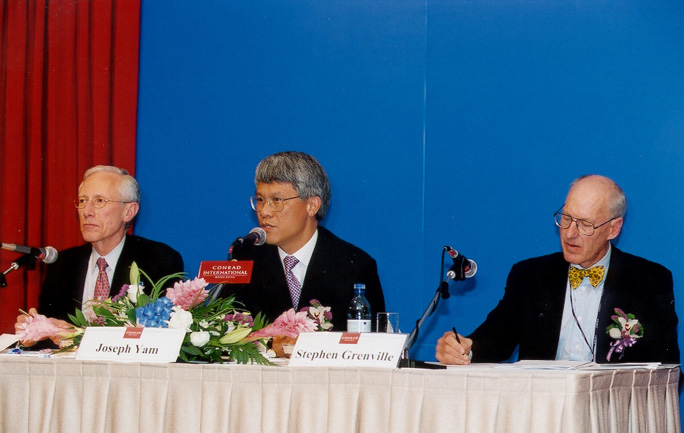
At the Fifth Hong Kong Monetary Authority Distinguished Lecture held today (May 21), Dr Stanley Fischer, Vice Chairman of Citigroup and former First Deputy Managing Director of the International Monetary Fund (left), delivers a lecture on the theme "The Asian Crisis: Lessons for the Future". Dr Stephen Grenville, Adjunct Professor of National Centre for Development Studies, Australian National University, Canberra and former Deputy Governor of Reserve Bank of Australia (right), is the Discussant, and Mr Joseph Yam, Chief Executive of the Hong Kong Monetary Authority (centre), chairs the Lecture.
For further enquires, please contact
Jasmin Fung, Manager (Press), at 2878 8246 or
Thomas Chan, Senior Manager (Press) at 2878 1480
Hong Kong Monetary Authority
21 May 2002